Quick answer
Identify the hardware before buying a funnel, syringe, refill, or travel atomizer. These four hardware situations need different paths:
| What you have | Correct path | Stop if |
|---|---|---|
| Full-size bottle with a removable spray head | Compatible bottom-fill travel atomizer | The exposed nozzle stem does not fit the atomizer valve |
| Refillable designer bottle | The brand’s matching refill and instructions | The refill name or bottle format does not match exactly |
| Screw-neck empty atomizer | Funnel, pipette, or transfer tool specified by its maker | The neck, seal, or liner looks damaged |
| Crimped or sealed decorative bottle | Leave the collar intact; use a supported transfer method only | You would need pliers, prying, or force |
A costly mistake is treating every bottle as if its top should unscrew. A sealed collar is part of the package. Bending it can create a leak and ruin a bottle that was never intended for direct refilling.
Before transferring anything, record the exact name, size, and any batch or opened-life marks. The perfume label guide explains what those details can establish without treating a batch code as an authenticity or expiry guarantee.
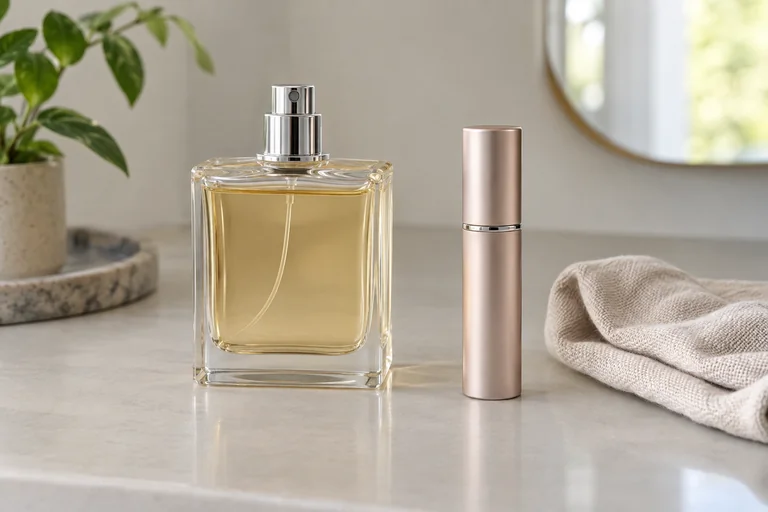
Method 1: pump-fill a compatible travel atomizer
This method moves a small amount of fragrance from a normal spray bottle into a portable atomizer.
For an atomizer whose manufacturer documents this method, remove only the permitted spray head and place the bottom valve over a compatible exposed nozzle stem. Follow the exact model’s fill instructions and level indication. Do not transfer another model’s compatibility or removable-vial features to a lookalike package.
Use the method only when the parts align naturally:
- Put the source bottle upright on a stable, wipeable surface.
- Remove only the small press-down spray head, not the metal collar around the bottle neck.
- Check that the exposed nozzle stem is straight and fits the atomizer’s bottom valve.
- Hold both pieces vertical and pump slowly.
- Watch the level indication and stop at the maker’s specified fill limit.
- Replace the source bottle’s spray head and test the travel atomizer over a sink or towel.
If the valve rocks, binds, or leaks at the joint, stop. An adapter that almost fits is not a compatible adapter.
Method 2: use a brand-specific refill
A designer refill is not a generic bottle of perfume. It is a product made for named refillable bottles.
Prada’s current Paradoxe refill page says its refill fits the Paradoxe bottle formats. That does not make the same refill compatible with another Prada fragrance, another Paradoxe flanker, or an unrelated triangular bottle.
Before ordering a refill, match all four details:
- fragrance name
- concentration or flanker
- bottle format
- refill size and mechanism
Use the brand’s own refill instructions and keep the bottle on a flat surface. Do not decant a branded refill through a funnel merely because the neck appears accessible; the refill mechanism is designed to control the transfer and closure.
Method 3: fill a screw-neck atomizer
An empty atomizer with a removable screw top may accept a funnel, pipette, or transfer syringe. Follow its instructions because the opening, liner, and seal differ between products.
Keep the tool dry, transfer slowly, and leave the space specified by the atomizer maker. Use the actual product’s fill limit rather than a universal percentage.
Use one atomizer for one fragrance where practical. Residue in a pump, gasket, or dip tube can alter the next scent even when the chamber looks empty.
Do not pry open a sealed collar
If the manufacturer does not describe the collar as removable, treat it as sealed. Do not use hand pressure as a test of whether it should open.
Pliers can scratch the finish, deform the collar, crack the neck, or leave a bottle that no longer closes correctly. A collectible, vintage, lacquered, or gift bottle has even more to lose from an improvised repair.
For a damaged sprayer, contact the brand or retailer first. If a supported transfer method is unavailable, preserving the bottle is better than forcing the hardware and losing the fragrance.
Compatibility checks before buying an atomizer
An atomizer is a good purchase only if it fits the source bottles you actually use.
- Confirm whether the spray head pulls off and exposes a straight nozzle stem.
- Check the atomizer maker’s compatibility language, not only a marketplace title.
- Prefer a visible level window.
- Choose replaceable vials if you rotate several fragrances.
- Avoid a listing that shows several incompatible fill methods without identifying the included parts.
- Keep the order details so you can identify the exact replacement vial later.
Obtain instructions for the exact atomizer before ordering. Lookalike containers do not necessarily use the same valve, compatible source bottles or replaceable vial.
Leak test before carrying it
After filling, wipe the exterior and let the atomizer sit upright on a clean tissue. Spray once or twice, replace the cap, then check the valve, collar, and tissue for fragrance.
Do not put a newly filled atomizer straight into a handbag, pocket, or luggage. If it leaks while upright at home, travel pressure and movement will not improve it.
Keep perfume away from heat and direct light. A car, sunny windowsill, or hot bag is a poor storage location for both the fragrance and its seals.
Make the refill decision before buying the full bottle
If portable use matters, check refill compatibility while choosing the perfume rather than after the bottle arrives. Our best everyday perfumes guide identifies exact fragrances and bottle sizes for regular wear, and our fragrance bottle-size guide helps decide whether a travel spray, smaller bottle, or refillable full size fits the routine.
Choose the Supported Method
Use a pump-fill atomizer only with a compatible removable spray head. Use a branded refill only with the exact bottle family named by the manufacturer. Use a funnel or pipette only with an atomizer designed to open that way.
If the job requires prying, forcing, or guessing, stop. The bottle is telling you that you have the wrong transfer method.
Frequently asked questions
Can every perfume spray bottle be refilled?
No. Some bottles use a brand-specific refill system, some have a removable spray head that fits a pump-fill atomizer, and some are sealed. Do not force a collar or neck that the manufacturer does not describe as removable.
How do you fill a bottom-fill travel atomizer?
For a compatible model, remove the perfume bottle’s spray head, place the atomizer valve vertically over the exposed nozzle stem, and pump while watching the level window. Follow the atomizer maker’s instructions and stop before overfilling.
Can you wash a pump-fill atomizer before changing scents?
Do not assume so. A replaceable inner vial can provide a separate container for each scent where that system is documented. Use one vial per scent unless the exact model’s manufacturer gives different cleaning instructions.
Is a perfume refill the same as a travel atomizer?
No. A brand refill replenishes a compatible full-size bottle, while a travel atomizer takes a small amount from a source bottle for portable use. Their valves and instructions are not interchangeable.