A useful perfume inventory answers three different questions: how many containers do I own, how many distinct fragrances do they represent, and how much usable liquid remains? Combining those into one “collection size” number creates duplicate purchases and misleading totals.
Start with one record per physical container, linked to the exact fragrance version. The worksheet below keeps records in this open page without an account. Export a JSON backup before leaving; there is no automatic browser storage or online collection.
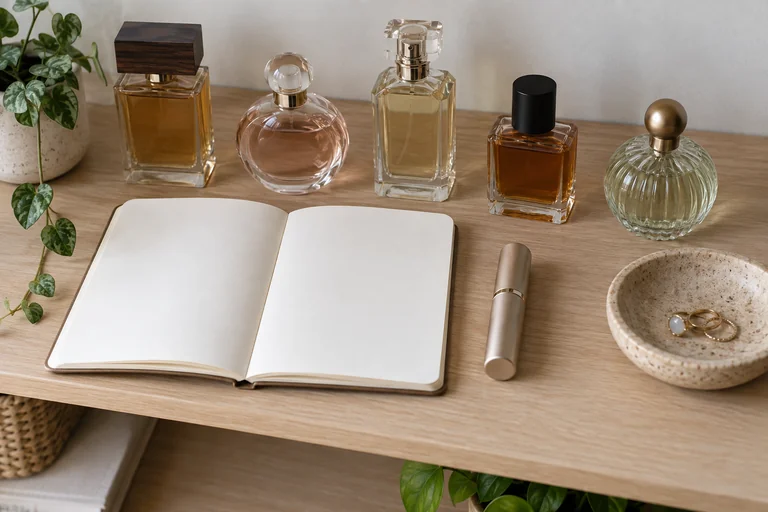
Count your actual containers
Perfume container inventory
Add one record per physical container. Exact brand, name and version link duplicates; unknown remaining amounts stay unknown.
The inventory starts empty. No example perfume is counted as yours. Your entries remain in this page. Export before leaving to keep records.
Use the worksheet to see your result.
Your records
Record a decant transfer
Both containers must have the same exact fragrance/version and known remaining amounts. The transfer updates both records without increasing total contents.
Add one record per physical bottle, vial or atomizer. Two bottles with the same brand, exact name and version count as two containers and one distinct version. An EDT and EDP are separate identities. Matching ignores letter case and extra spaces; it does not resolve misspellings, flankers or reformulations for you.
Record remaining liquid separately from capacity. A blank remaining amount stays unknown and is excluded from the entered-mL subtotal rather than silently counted as zero. Visual estimates are labeled as estimates. Owned empty containers count as packaging with zero liquid; records marked no longer owned are excluded from owned totals. Search covers the entered identity and container ID.
Use Edit to update a record and Delete to remove an erroneous entry. For a measured decant transfer, create the destination container first and enter its current contents, including zero if empty. The transfer control checks matching identity, known amounts, source contents and destination capacity, then updates both records. In the hypothetical 40 mL bottle/empty 5 mL atomizer example below, moving 5 mL leaves 35 + 5 = 40 mL; the total does not grow.
Export JSON to preserve the worksheet fields and IDs for later import into an empty session. CSV is a readable spreadsheet copy. Text values that could be spreadsheet formulas are escaped in CSV. Imported data is validated and remains local. Neither format proves authenticity or that an estimated amount is physically accurate. Up to 500 records and a 2 MB JSON import are supported in one session. Method and arithmetic reviewed October 15, 2026.
Use two identifiers
Give each fragrance an identity that includes brand, full name and concentration. Give each container a separate identifier. A full bottle, travel spray and decant of the same EDP are three containers of one fragrance. An EDT and EDP sharing a name should not automatically be merged.
Keep batch markings and photographs where useful, but do not infer a reformulation or authenticity result merely from a different batch code. Record the observed marking and purchase provenance without adding a conclusion you cannot support.
Minimum fields that answer real questions
| Field | Example of the question it answers |
|---|---|
| Container ID and linked fragrance identity | Is this another container of a fragrance I already own? |
| Format and labeled capacity | Is it a 2 mL sample, 10 mL travel spray or 50 mL bottle? |
| Remaining amount and estimate method | Is “half full” a visual guess or a recorded transfer? |
| Status | Open, unopened backup, empty, transferred out or no longer owned? |
| Storage location | Where is the item physically located? |
| Purchase source/date and opening date if known | What history can I actually document? |
| Last worn and a short personal note | Do I use it, and what do I want to remember? |
Unknown is a valid entry. Do not substitute the purchase date for an unknown manufacture date, or assume that the labeled bottle capacity is its current contents.
Prevent the decant double count
Consider this hypothetical transfer, with no wear or loss during the transfer:
| Container | Before transfer | After transferring 5 mL |
|---|---|---|
| Main 50 mL-capacity bottle | 40 mL remaining | 35 mL remaining |
| Empty 5 mL travel atomizer | 0 mL | 5 mL |
| Total contents owned | 40 mL | 40 mL |
The transfer increases neither the quantity owned nor the number of distinct fragrances. Logging “40 mL bottle plus 5 mL decant” afterward incorrectly creates five extra milliliters. If amounts are only visual estimates, label the total approximate instead of displaying false precision.
If you give that decant away, change its ownership status and remove its contents from your owned total. Keep the record if useful, but do not let archived items inflate the active collection.
Choose a format by the task it must perform
A notes app or paper list can handle a collection where locating items is the main problem. A spreadsheet is useful when you want to filter by fragrance, status or location and calculate quantities. A database can link fragrance identities to many containers, but adds setup work.
These are workflow differences, not a premium-product ladder. Use something you already have before paying for a new tracker. Check export and backup options if the records will be difficult to recreate. A paper record can be photographed for backup; a digital format still needs a usable copy outside a single device or account.
Reconcile against the shelf
Update a record when an item arrives, moves, opens, is transferred or leaves the collection. Pick a review interval that fits how often it changes. During that review, physically locate each active container and resolve duplicates rather than adding more fields to stale records.
Optional wear and occasion tags should describe your own preferences. They are not automatic assignments such as “citrus for work” or “amber for evening.” No tracker can establish that a perfume is welcome in a fragrance-free setting.
Before a purchase, search the exact identity and its linked containers, including unopened backups. Then ask whether the purchase replaces an actual shortage or creates another bottle of something you already have. For spending, use the separate monthly fragrance budget calculator ; bottle count and affordability are different questions.